Offline intelligence
LLMs are awesome and incredibly useful. They are essentially a compressed library of all human knowledge, accessible through a simple messaging interface. Medicine, agriculture, engineering, chemistry, survival skills, language translation... you name it.
For some reason, I frequently think of a world where we no longer have access to LLMs. It's probably because LLMs are so useful that they become essential in your worflows. A part of this is probably due to the fact that I know I'm renting access to these amazing systems and (although unlikely) I could have them taken away from me without my control.
99.9% of people who use LLMs don't own them. The model lives on someone else's server, powered by someone else's electricity, connected through someone else's infrastructure. If any of those things go away, so does your access.
That's probably fine. But "probably" isn't "definitely."
The odds of a total grid-down scenario are low. But they aren't zero. Solar storms, nuclear conflict, coordinated cyberattacks on power infrastructure, governments shutting down internet access.
And here's what makes it worth thinking about: modern humans are remarkably dependent on systems we don't understand. Most of us don't grow food. We can't identify infections or set a broken bone. We don't know how to purify water, build shelter, generate electricity, or preserve food for winter. We've outsourced all of this knowledge to specialists and supply chains. If those supply chains break, we're left with whatever knowledge is in our heads. For 99.9% of us, it's not enough to survive 100 days.
Imagine a scenario where the grid goes down or your access is taken away. But sitting in your home is a computer running a large language model, powered entirely by solar panels. No internet required. No cloud. No subscription. Just you and a machine that holds all of human knowledge, ready to walk you through whatever you need.
This isn't science fiction. Every piece of this is available today, off the shelf, for less than you'd spend on a used car. The setup is simpler than you'd think!
The System
There are two parts of the system: the computer and the power.
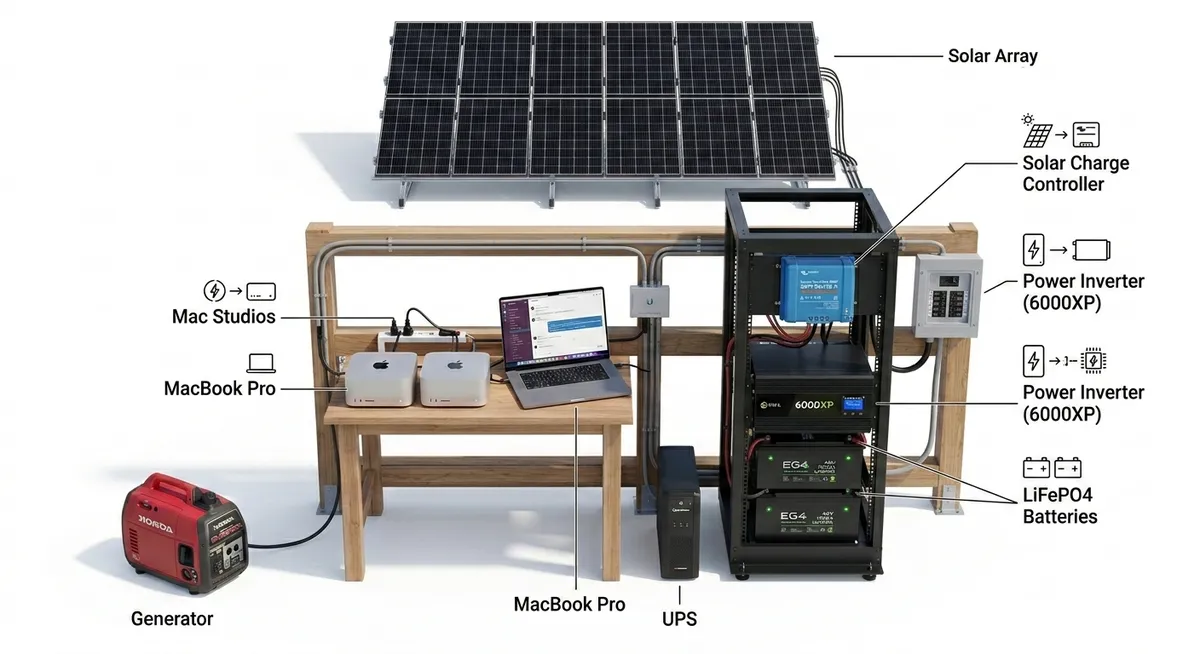
Solar panels convert sunlight into electricity. That electricity is stored in batteries so you have power day and night. The batteries feed into a computer that has an open-source LLM pre-downloaded onto its hard drive. Everything runs locally, on your machine, powered by the sun.
No grid. No internet. No subscription. No dependency on anyone or anything except sunlight.
Computer Setup
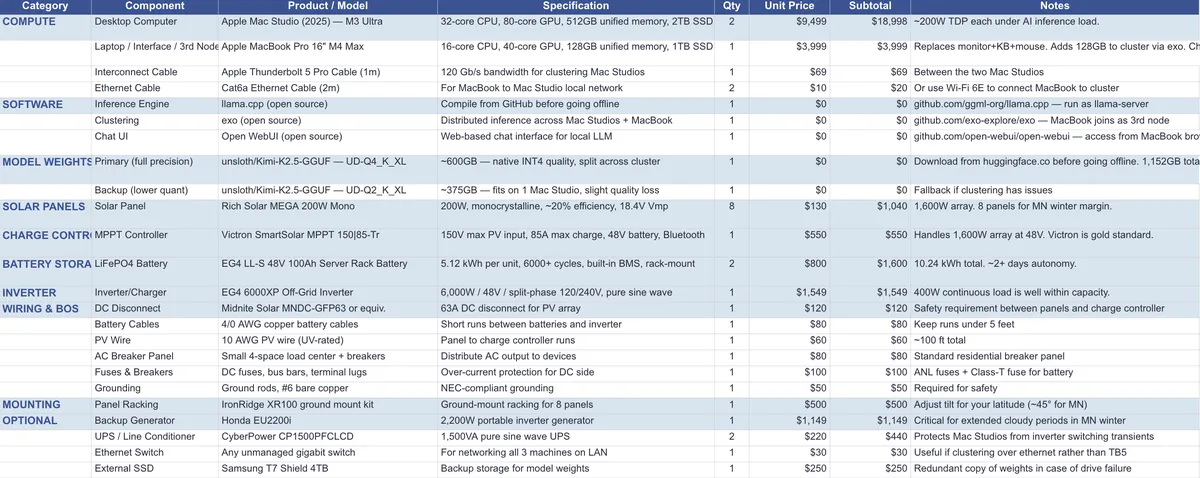
You need a machine capable of running an open-source LLM entirely offline. The best option today is a cluster of Mac Studio's.
You also need a monitor, keyboard, and mouse to control the computer. You can even choose to use a MacBook for this as a 3-in-1 while also getting more compute power.
Power Setup
You need to generate and store your own electricity. This is the same setup that off-grid cabins, boats, and RVs have used for decades. There are four components:
- Solar panels sit outside and convert sunlight into electricity.
- Batteries store the energy so you have power at night and on cloudy days.
- A charge controller regulates the flow so your batteries don't overcharge.
- An inverter converts the stored power into the type your computer expects from a wall outlet.
Sun hits panels. Panels charge batteries. Batteries power computer. That's the whole system.
Component breakdown
Is it worth it?
That depends on how you think about risk.
Suprisingly, large-scale grid failures happen regularly. In 2003, a single power line brushed against an untrimmed tree in rural Ohio and triggered a cascading failure that left 50 million people across the northeastern US and Canada without power for up to four days. In 2012, northern India suffered back-to-back grid collapses that affected 670 million people — roughly 10% of the world's population at the time. Brazil, Indonesia, Turkey, and others have all experienced blackouts affecting tens of millions.
None of this means the grid will collapse tomorrow. It probably won't. But "probably won't" and "definitely won't" are very different things, and the cost of being wrong is total loss of access to the knowledge systems modern life depends on.